


Three Books Offer New Ways to Think About Environmental Disaster
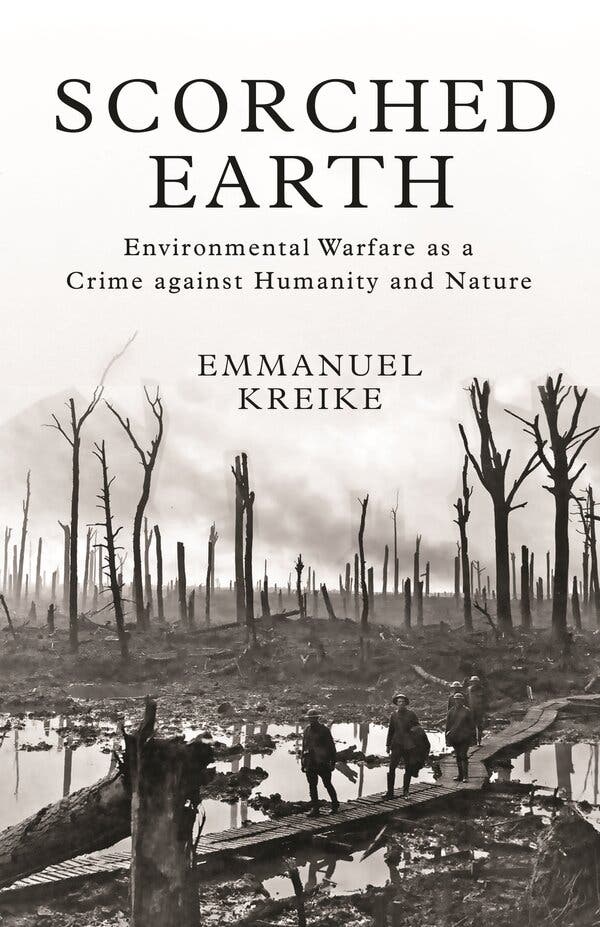
SCORCHED EARTH
Environmental Warfare as a Crime
Against Humanity and Nature
By Emmanuel Kreike
521 pp. Princeton University. $29.99.

In the first sentence of this sweeping history, Kreike tells us that most books about total war begin in 1914, in the fields and forests of Flanders, out of the mistaken perception that World War I was the first time that chemical warfare was deployed.
Kreike, however, starts in the sodden fields of the Low Countries during the Dutch Revolt in the 1500s, visits the European wars of conquest in the Americas and Asia and the internal European conflicts during the “Age of Reason,” then ends in southwestern Africa during the early 20th century.
Kreike’s argument is that environmental warfare, in which nature is a tool and a target, has occurred for hundreds of years, perpetrated by people all over the world, and that environcide (a term my brain wants to autocorrect to “envirocide”) should be considered a crime against humanity.
“Environcide consists of intentionally or unintentionally damaging, destroying or rendering inaccessible environmental infrastructure” — which he broadly defines as homes, agriculture, water sources and more — “through violence that may be episodic and spectacular … or continuous and cumulative.”
At times, this seems like tautology — it’s hard to imagine a war of any kind that wouldn’t fit this description. But there are significant contributions here. First, Kreike, despite relying heavily on Dutch sources (dam enthusiasts will love the details), helps return historical agency to non-European actors in the wars of colonization around the world. He writes about often forgotten and impressive environmental infrastructure, resistance to European invasion and successful adaptation — for example, many tribal nations of the American West turned to buffalo hunting only after Europeans had made their previous sedentary agricultural traditions impossible.
Kreike offers a stark corrective and an implicit warning: Humanity is not distinct from nature, and assuming it is can have tragic outcomes. Climate change is one; pandemics are another. In this book, catastrophic warfare is a third. Waiting for the fourth horseman would seem unwise.
HOW TO PREPARE FOR CLIMATE CHANGE
A Practical Guide to Surviving the Chaos
By David Pogue
610 pp. Simon & Schuster. Paper, $24.
It’s always a good idea to prepare for a disaster, especially one you see coming.
Pogue, a former New York Times tech columnist and current contributor, has got you covered. This is a climate change worst-case scenario survival guide: stronger hurricanes, forest fires, droughts, tick- and mosquito-borne illnesses, heat waves, tornadoes, plus how to prepare your business and also how to invest your money before the capitalist superstructure crumbles, apparently. (“Preparing for Social Breakdown” is one chapter.)
If Pogue is living the life he’s advising, he is eating homegrown beans, calmly explaining the crisis to his children and monitoring their psychological health, asking his contractor to deepen the soffits in his roof on which he is mounting solar panels, buying several air purifiers and organizing with his fellow citizens.
Much of the book, especially the sections on what to look for in an insurance policy, is helpful. It also includes an explanation of climate science and the obligatory feel-good sections on hope: actions some are taking and how you can participate.
It wouldn’t be wrong to do as he suggests; climate change will make these disasters worse and more frequent. Still, there’s something unsettling about the project, especially since many can’t act as advised, for financial or other reasons, and the real problem is that governments and corporations are failing us.
A particularly eerie chapter covers which American cities will “do well” in a warmer climate. This isn’t a new idea; it’s not necessarily wrong to lay out the climate risks of living in some places and the benefits of others. But, who is this advice for? Not everyone can move to Boulder, Colo., to take advantage of its hiking trails and ambitious climate targets.
What about the rest of us, the people who can’t afford or wouldn’t want to move away from the Gulf Coast? What about the people who already live in Boulder, or the diminishing water supply in the Rockies? No book can do everything, but planning for our collective future should be about everyone, including those without the means to prepare, since they are in the most danger. Inequality is a large part of what got us here; preparing for climate change shouldn’t make that worse.
HOW TO BLOW UP A PIPELINE
By Andreas Malm
200 pp. Verso. Paper, $19.95.
In September 2019, millions of people around the world participated in nonviolent demonstrations demanding action on climate change. Over and over again, politicians and business leaders have said that we face an existential threat. And yet, from 2017 to 2019 investments in new fossil fuel infrastructure projects have grown. To become profitable (and then some), these new projects will pump more greenhouse gases into the atmosphere for decades.
Meanwhile, the polar icecaps melt, sea levels rise, hundreds of thousands of species may go extinct, fires rage, hurricanes boil, people continue to suffer and die.
“To say that the signals have fallen on the deaf ears of the ruling classes of this world would be an understatement. If these classes ever had any senses, they have lost them all,” writes Malm, a Swedish professor of human ecology and climate change activist, in his compelling but frustrating treatise.
A proportionate and rational response, Malm argues, should be to target fossil fuel infrastructure: Destroy fences around a power plant; occupy pipeline routes, as protesters did for the Keystone XL and Dakota Access pipelines; at coal mines or similar sites, set up climate camps, which Malm believes are effective as laboratories for activism and for shutting things down by putting bodies on the line.
He also advocates powerfully against despair and powerlessness. One of the most satisfying parts of his book comes when he brutally dispatches with “climate fatalists” like Jonathan Franzen, who argue that we should all just give up. “Climate fatalism is for those on top,” Malm writes. “Its sole contribution is spoilage.”
So Malm wants us to fight back (though I should add that there aren’t any actual instructions here about how to blow anything up).
He argues that there should be room for tactics other than strict nonviolence and peaceful demonstrations — indeed, he is a bit contemptuous of those who offer strategic pacifism as a solution — and notes that fetishizing nonviolence in past protest movements sanitizes history, removing agency from the people who fought, sometimes violently, for justice, freedom and equality.
Sure. But the problem with violence, even if it’s meant only to destroy “fossil capital,” is that ultimately it’s impossible to control.

Advertising by Adpathway