


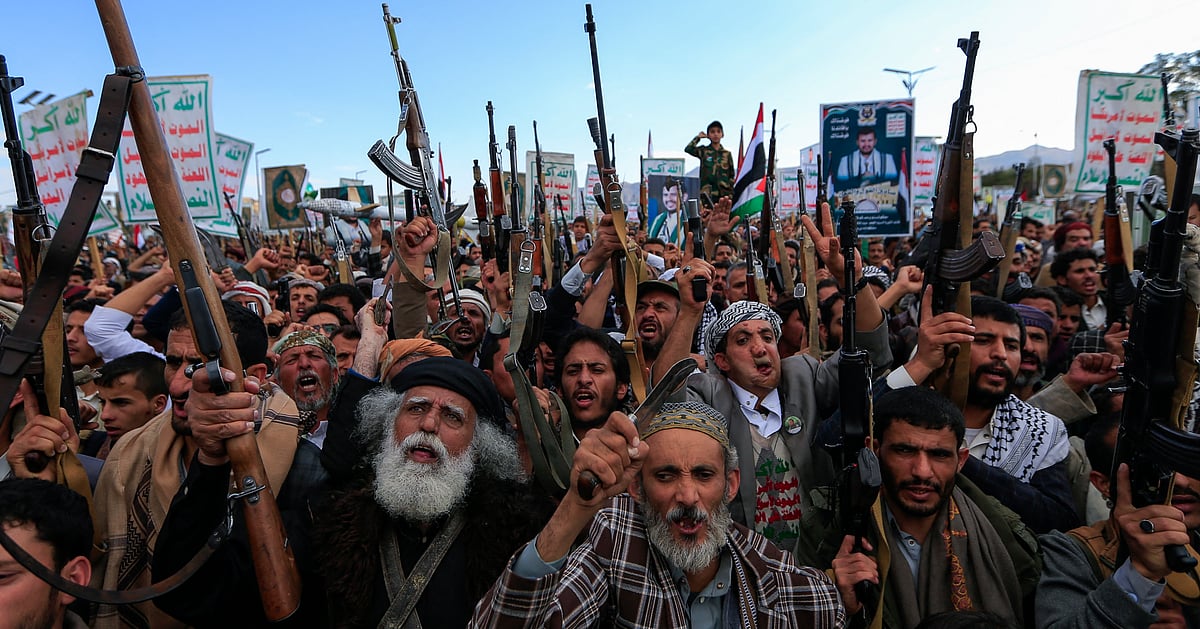
'Resilent fighters': why Yemen's Huthis are no pushover for US
Dubai, United Arab Emirates: US military, be warned: after years of fighting in rugged terrain and weathering thousands of air strikes, Yemen's Huthi rebels are not to be taken lightly, experts say.
Despite a heavy US bombardment announced by President Donald Trump that left dozens dead, the battle-hardened, Iran-backed Huthis remain defiant, and with good reason.
The group from the mountainous north, which controls swathes of impoverished Yemen, has withstood a decade of war against a well-armed, Saudi-led international coalition.
If anything, the Huthis, from the Zaidi branch of Shia Islam, are now even more entrenched, and were moving towards a peace process with Riyadh before the Gaza war put talks on hold.
"The challenge of defeating the Huthis should not be underestimated," said Elisabeth Kendall, director of Girton College at the University of Cambridge, calling them "resilient fighters".
Saturday's US attacks killed 53 people and wounded 98, according to Huthi authorities, who said they hit back with multiple strikes on a US aircraft carrier group.
The US action was aimed at ending Huthi threats to Red Sea shipping after the rebels warned they would resume their months-long campaign, which they say is in solidarity with Palestinians in Gaza.
On Monday, tens of thousands of people joined Huthi-organised rallies to protest the US strikes.
"They will not be easy to defeat," Kendall said.
- 'Dispersal of weapons' -
After the rebels seized the capital, Sanaa, in 2014, ousting the internationally recognised government, the Saudi-led coalition -- which includes the United Arab Emirates, and is aided by Western weaponry -- declared war the following March.
Since then, Kendall said, more than 25,000 coalition air strikes have rained down on Huthi-held Yemen, which encompasses most of the 38 million plus population of the Arabian Peninsula's poorest country.
For more than a year, the Huthis have also faced American, British and Israeli strikes aimed at curbing the Red Sea harassment campaign that has choked the vital trade route.
According to Alex Plitsas of the Atlantic Council, Yemen's weaponry, including mobile missile launchers, is hard to find and destroy.
"The Huthis' ability to persist stems from their dispersal of weapons across Yemen's rugged terrain, complicating targeting efforts," Plitsas wrote on the think tank's website.
And while intelligence operations badly weakened Iran-allied Hamas and Hezbollah -- both hobbled by Israeli assassinations -- the Huthis are not infiltrated in the same way.

Advertising by Adpathway